Last Posts

Search

Wednesday, October 31, 2012

New Fossils Suggest Ancient Origins of Modern-Day Deep-Sea Animals

These are fossils of deep sea fauna discovered off the coast of Florida. 


A collection of fossil animals discovered off the coast of Florida suggests that present day deep-sea fauna like sea urchins, starfish and sea cucumbers may have evolved earlier than previously believed and survived periods of mass extinctions similar to those that wiped out the dinosaurs.

The full results are published Oct. 10 in the open access journal PLOS ONE by Ben Thuy and colleagues from the University of Göttingen, Germany.

Previously, researchers believed that these present-day animals evolved in the relatively recent past, following at least two periods of mass extinction caused by changes in their oceanic environment. The new fossil collection described in this study predates the oldest known records of the present-day fauna. "We were amazed to see that a 114 million year old deep-sea assemblage was so strikingly similar to the modern equivalents," says lead author Ben Thuy.

According to the authors, this evidence shows that the ancestors of modern deep-sea animals have lived in these deep waters for much longer than previously thought. That this collection of fossils appears to have survived several drastic changes in oceanic climates also suggests that deep-sea biodiversity may be more resilient than shallow-water life forms, and more resistant to extinction events than previously thought.

Duck-Bill Dinosaurs Had Plant-Pulverizing Teeth More Advanced Than Horses

This cross-section of a duck-billed dinosaur tooth (Edmontosaurus) shows the remarkably complex architecture. Six main tissues compose the tooth, where most reptiles only have two (enamel and orthodentine). Like horse, bison, and elephant teeth, the myriad of tissues--each with their own unique wear attributes--allowed the teeth to self-wear with use to form complex grinding surfaces. These dinosaurs possessed among the most sophisticated teeth known. (Credit: G. M. Erickson/Florida State University)


 A team of paleontologists and engineers has found that duck-billed dinosaurs had an amazing capacity to chew tough and abrasive plants with grinding teeth more complex than those of cows, horses, and other well-known modern grazers. Their study, which is published October 4 in the journal Science, is the first to recover material properties from fossilized teeth.

Duck-bill dinosaurs, also known as hadrosaurids, were the dominant plant-eaters in what are now Europe, North America, and Asia during the Late Cretaceous about 85 million years ago. With broad jaws bearing as many as 1,400 teeth, hadrosaurids were previously thought to have chewing surfaces similar to other reptiles, which have teeth composed of just two tissues -- enamel, a hard hypermineralized material, and orthodentine, a soft bonelike tissue. But paleontologists who study the fossilized teeth of these animals in detail suspected that they were not that simple.

"We thought for a long time that there was more going on because you could just look at the surface of the tooth and see advanced topography, which suggests that there are many different tissues present," said Mark Norell, chair of the American Museum of Natural History's Division of Paleontology and an author on the paper.

To investigate the dinosaurs' dental structure and properties in depth, Norell worked with lead author Gregory Erickson, a biology professor at Florida State University, and a team of engineers on a series of novel experiments. Erickson sectioned the fossilized teeth and made microscope slides from them. These revealed that hadrosaurids actually had six different types of dental tissues -- four more than reptiles and two more than expert mammal grinders like horses, cows, and elephants. Using a technique called nanoindentation, in which a diamond-tipped probe is indented and/or drawn across the fossilized teeth to mimic the grinding of abrasive food, the researchers determined the differential hardness and wear rates of the dental tissues.

Erickson, who describes hadrosaurid dinosaurs as "walking pulp mills," said, "We were stunned to find that the mechanical properties of the teeth were preserved after 70 million years of fossilization." He went on to comment that "if you put these teeth back into a living dinosaur they would function perfectly."

In addition to the four dental tissues found in mammals -- enamel, orthodentine, secondary dentine that helps prevent cavities, and coronal cementum that supports the teeth's crests -- the hadrosaurid teeth include giant tubules and a thick mantle dentine. These extra tissues are thought to provide additional prevention against abscesses. Also unlike mammalian teeth, the dental tissue distribution in hadrosaurids greatly varied in each tooth.

Together, these characteristics suggest that hadrosaurids evolved the most advanced grinding capacity known in vertebrate animals, which might have led to their extensive diversification.

"Duck-bills' advanced tissue modification appears to have allowed them to radiate into specialized ecological niches where they ate extremely tough plants like fern, horsetail, and ground cover that were not as easy for dinosaurs with shearing teeth to eat," Norell said. "Their complex dentition could have played a major role in keeping them on the planet for nearly 35 million years."

In addition, the findings provide strong evidence that dental wear properties are preserved in fossil teeth -- an idea that was once questioned and overruled in this study with comparative tests on teeth from modern and fossilized horses and bison. This opens the door for studies on the dental biomechanics of fossils from wide-ranging groups of animals to better understand evolutionary modifications in diets.

Beautiful" Squirrel-Tail Dinosaur Fossil Upends Feather Theory


The skull of a new species of dinosaur glows green under ultraviolet light. 
A newfound squirrel-tailed specimen is the most primitive meat-eating dinosaur with feathers, according to a new study. The late-Jurassicdiscovery, study authors say, challenges the image of dinosaurs as "overgrown lizards."

Unearthed recently from a Bavarian limestone quarry, the "exquisitely preserved" 150-million-year-old fossil has been dubbed Sciurumimus albersdoerferi—"Scirius" being the scientific name for tree squirrels.

Sciurumimus was likely a young megalosaur, a group of large, two-legged meat-eating dinosaurs. The hatchling had a large skull, short hind limbs, and long, hairlike plumage on its midsection, back, and tail.

"I was overwhelmed when I first saw it. Even apart from the preservation of feathers, this is certainly one of the most beautiful dinosaur fossils ever found," said study leader Oliver Rauhut, a paleontologist at the Bavarian State Collections of Palaeontology and Geology in Germany.

Goodbye, Overgrown Lizards?

Previously, paleontologists have found feathers only on coelurosaurs—birdlike dinosaurs that evolved later than so-called megalosaurs such as Sciurumimus.

Because Sciurumimus is not closely related to coelurosaurs, the new fossil suggests feathered dinosaurs were the norm, not the exception, Rauhut said.

"Probably all dinosaurs were feathered," he added, "and we should say good bye to the familiar image of the overgrown lizards."

Previous research had already suggested that feathers were widespread in theCretaceous and late Jurassic periods , noted Corwin Sullivan, a paleontologist at the Chinese Academy of Sciences in Beijing—even if few specimens have been found.

Feathered-dinosaur remains are sparse because "we only find them in places where conditions were just right for their bodies to be buried and preserved in a way that kept the feathers as well as the bones intact," Sullivan, who was not involved in the research, noted by email.

Dinosaur-Feather Evolution Still Up in the Air

More interesting, according to Sullivan, is what Sciurumimus means for how dinosaurs evolved feathers.

Scientists weren't sure if dinosaurs other than coelurosaurs had feathers. ButSciurumimus is "the first clear evidence" that feathers predated those birdlike dinosaurs, Sullivan said.

Other than meat-eating dinosaurs, hair-like feathers are also known in two bird-hipped dinosaurs, a completely different branch of the dinosaur family tree.

According to the study authors, this "obviously" suggests that dinosaurs' common ancestor had feathers, which passed the trait on to each branch of the dinosaur family tree. 

"I would say that this is an obvious possibility, rather than an obvious conclusion," Sullivan said.

Although the feathers of bird-hipped dinosaurs look similar to those of Sciurumimus and primitive coelurosaurs, it's still possible the trait evolved independently, and not in a common ancestor.

"We paleontologists are going to need to find more fossils—of things even less closely related to birds than Sciurumimus—to be sure."

Squirrel-tailed dinosaur study published this week in the journal Proceedings of the National Academy of Sciences.

Tuesday, October 30, 2012

New Fanged Dwarf Dinosaur Found—"Would Be Nice Pet"

A sculpture of a fanged dinosaur as it appeared in life.
A new, tiny dinosaur with vampire-like fangs devoured ... plants?

So says a new study of Pegomastax africanus, a 2-foot-long (0.6-meter-long) heterodontosaur that lived about 200 million years ago. 
P. africanus small, fanged dinosaur species that were "scampering around between the toes of other dinosaurs at the dawn of the dinosaur era," said study author Paul Sereno, a National Geographic Society explorer-in-residence. 

Covered in porcupine-like quills and sporting a blunt, parrot-like beak, P. africanus would've looked like a "strange little bird," said Sereno, a paleontologist with the University of Chicago.


But its fangs, Sereno argues, were more like those of the piglike peccary (picture) or fanged deer, or water chevrotain (video)—modern-day, plant-eating mammals that use their teeth for self-defense and foraging.

The species, he added, would have lived along forested rivers in southern Africa around the time the supercontinent Pangaea had just begun to split into the northern and southern landmasses.

Reconstructing the Oddball

While preparing a comprehensive analysis of the little-known heterodontosaurs, Sereno identified P. africanus from fossils at Harvard University, which had been collected in South Africa in the 1960s.

To find out what the newfound dinosaur did with its sharp fangs, Sereno then reassembled P. africanus' jaw and teeth. He compared the reconstruction to jaws and teeth of both meat-eating dinosaurs and modern plant-eating mammals with fangs.

Sereno discovered that P. africanus' fangs were very similar to those of fanged deer and peccaries, which use their fangs in self-defense and competition for mates, he said.

Supporting this theory, microscopic analysis of P. africanus' fang enamel revealed wear and breakage consistent with sparring.

The researcher suggested too that the cheek teeth in P. africanus' upper and lower jaws worked like self-sharpening scissors for shearing plant parts, as detailed in the study, published online Wednesday in the journal ZooKeys.

Tiny Dinosaur Ahead of Its Time

Finding a new species of heterodontosaur is not "all that noteworthy," Hans-Dieter Sues, a vertebrate paleontologist at the National Museum of Natural History in Washington, D.C., said by email.

"But [Sereno's] comprehensive review of the entire group of these odd little dinosaurs is a landmark contribution," said Sues, who wasn't involved in the study. 

In particular, Sues is impressed that Sereno "worked out how these dinosaurs chewed their food, which helps understand their peculiar, molar-like teeth."

What's more, the study revealed that P. africanus' sophisticated jaw structure was ahead of its time, Sereno noted. Such structures evolved again millions of years later in mammals.

If the housecat-size dinosaur lived today, he quipped, "it would be a nice pet—if you could train it not to nip you."

Video: Reconstructed Heterodontosaurus, Cousin to the New Species 

Evolutionary Flop: Early 4-Footed Land Animal Was No Walker?


Ichthyostega picture: early walking land animal
One of Earth's earliest four-footed land animals couldn't walk, a new 3-D model suggests.

Instead, the dog-size Ichthyostega likely flopped on land, using only two of its four stubby legs for locomotion.

One of our most distant ancestors, Ichthyostega is also one of the earliest tetrapods known to have crept onto land.

Until recently, researchers thought the creature squiggled across the mud on all fours like a salamander. But the first 3-D digital reconstructions ofIchthyostega's skeleton suggest its forearms couldn't twist and turn enough to enable a four-legged gait.

The model also suggests that the creature's hind legs barely touched the ground. At best, they may have propped up Ichthyostega's rump as the animal flopped around like a modern-day mudskipper fish.

"When Ichthyostega fossils were first being found in Greenland in the 1920s, the natural assumption was that something with four limbs with digits could walk," said paleontologist Stephanie Pierce, of the Royal Veterinary College in London.

"But now we have more fossil specimens, more species, and more tools," said Pierce, who co-authored the new Ichthyostega study, published May 23 by the journal Nature.

"We definitely know that they were moving more like a mudskipper than [like] modern tetrapods."

"Magic" Fossils

Four-limbed land animals with skeletons first arose in the water, scientists think. Only after millions of years of evolutionary change did they hit the beach during the Devonian period (prehistoric time line).

The earliest signs of their transition from swimming to walking are fossilized tracks that date back about 390 million years—about 30 million years before the first evidence of Ichthyostega was laid down.

To see how Ichthyostega might have made tracks, Pierce and her colleagues built a 3-D computer model by scanning a remarkably complete fossil from Greenland dubbed "Mr. Magic." Missing parts were filled in with scans of fossil bones from 12 other Ichthyostega specimens.

For comparison, the team also scanned and modeled the skeletons of a modern crocodile, otter, seal, platypus, and salamander.

"We moved the animals in a controlled way in the model, and Ichthyostegaseemed to be very different from its modern counterparts," Pierce said. "This really highlighted the fact that Ichthyostega must have been doing something different with its legs. The question is, what?"

More Like a Mudskipper

Further analysis hinted that Ichthyostega had very limited forearm motion and a stiff spine. The model also suggested that the hind limbs couldn't contribute to a forward-propelling, four-legged gait.

Instead, Pierce and her colleagues concluded, Ichthyostega likely "rowed" its forelimbs front-to-back, much as a mudskipper moves its stubby front fins to slide around in the muck.

Per Ahlberg, a paleontologist at Uppsala University who calls Ichthyostega "a close friend," said Pierce and her colleagues' work is the first and most thorough of its kind for animals transitioning from water to land.

"This is a really valuable, proper 3-D reconstruction of a Devonian tetrapod and an early land vertebrate," said Ahlberg, who wasn't involved in the study.

One item Ahlberg took issue with in the study, however, is the notion thatIchthyostega didn't do much with its hindquarters.

"There would have been a lot of muscle attachments there, and the pelvis is very large," especially compared with a fish pelvis, he said. That pelvis "had to be doing something significant or it wouldn't be there—the evolutionary cost is too large."

Pierce's team contends, however, that the hind limbs and pelvis were used more in swimming and paddling—Ichthyostega's primary means of motion, the team believes. Uppsala's Ahlberg added, "I bet Ichthyostega's stiff spine made it look bizarre when it was swimming. Sort of like a windup fish toy that you put in a bathtub."

Next, Pierce and her colleagues intend to perform nuanced calculations on the spine and reconstruct a full, lifelike model of movement for the ancient creature.

"The land was an open ecological niche, free to be exploited, and these early tetrapods knew what to do. It was theirs for the taking," Pierce said. "We want to see how they navigated this new environment."

Dinosaurs' Gaseous Emissions Warmed Earth?

An illustration of sauropod dinosaurs migrating.
Dinosaurs may have helped warm ancient Earth via their own natural gaseous emissions, a new study says.

Like modern-day ruminants, giant plant-eating dinosaurs likely had microbes in their guts that gave off large amounts of methane—a potent greenhouse gas even more effective at trapping heat than carbon dioxide.

Today cows, goats, sheep, giraffes, and other ruminants contribute to global warming by releasing as much as 50 million to 100 million metric tons of methane per year—a significant chunk of the 500 million to 600 million metric tons emitted annually, mostly due to human activity, according to the World Meteorological Organization.

The cud-chewing animals have large forestomachs packed with microbes that break down coarse plant material. The main byproduct of the process is methane—and it's got to go somewhere.

"Methane can come out of either end of an animal. For example, with cows it's mainly the front," said study co-author Dave Wilkinson, an ecologist at Liverpool John Moores University in England.

As for how these approximately 20-ton beasts—the largest of all known dinosaurs—expelled their methane, Wilkinson said, "we don't have any strong view on what happened with sauropods."

Sauropods as Huge Methane Sources

To estimate how much methane sauropods emitted, the scientists guessed that there were roughly ten sauropods per square kilometer (0.4 square kilometer) of vegetated land.

The team's analyses of modern ruminants suggest a sauropod might give off about 4.2 pounds (1.9 kilograms) of methane daily. A U.S. cow, by comparison, might give off a daily average of 0.4 to 0.7 pound (0.2 to 0.3 kilogram).

Assuming there were 29 million square miles (75 million square kilometers) of vegetated land when sauropods lived, their global methane production might have reached a whopping 520 million metric tons annually.

"When it first occurred to us to wonder what the methane output of sauropods was, I would have guessed rather less than our maths eventually predicted," said Wilkinson, whose study appears May 8 in the journal Current Biology.

"Clearly there are large uncertainties attached to our estimates, but they suggest that the amount of methane given off by sauropods may have been approximately equal to all modern global methane sources, both natural and manmade."

Methane Study Based on Educated Guesses

Wilkinson and colleagues admit they made a number of educated guesses in their analyses, and digestive physiologist Marcus Clauss agrees.

Clauss—who wasn't part of the study—noted, for example, that the team's calculations of methane emissions based on body weight were made from measurements of modern reptiles and mammals, not birds, which are the closest living relatives to dinosaurs.

The problem is that it's still unknown how much methane plant-eating birds release.

"If we would find that herbivorous birds produce less methane than similar-size herbivorous mammals, then ... the whole calculation might have to be redone," said Clauss, of the University of Zurich.

Regardless of the calculations, fossil finds make it clear that sauropods lived in a much warmer world than we do. "People sometimes describe it as a super-greenhouse," study co-author Wilkinson said.

To better link dinosaur emissions to the warming, the University of Zurich's Clauss suggests that climate modelers and paleontologists begin looking for signs of an uptick in methane during the sauropod heyday.

After all, study co-author Wilkinson added, then as today, "life can play a major role in shaping the physics and chemistry of its environment."

Pictures: Oldest Reptile Embryos Discovered


  Oldest reptile embryo pictureEmbryo picture: mesosaur baby ready to hatch
A fossil of a mesosaur skeleton is seen in a recent photograph. The black bar at bottom right indicates a scale of ten millimeters.

Piñeiro suspects some mesosaur species gave birth to live young, while others laid eggs but kept those eggs in their uteruses for a long time.

In the latter scenario, a mother mesosaur may have laid her eggs near water, where the baby would have hatched following a short incubation period of a few days or mere hours, she said.
Mesosaur fossil pictureOldest reptile embryo illustration

Monday, October 29, 2012

One-Ton Feathered Dinosaur Found: Fluffy and Fierce

yutyrannus-feathered-dinosaur.jpg
A newly discovered giant feathered dinosaur—a distant cousin of Tyrannosaurus rex—sported a fine down coat, making it the largest feathered animal known to have lived, scientists say.

Paleontologists already knew that some members of the group of dinosaurs to which T. rex belonged, called theropods, were feathered. But most of the known feathered dinos were relatively small.

"It was a question mark whether larger relatives of these small theropods were also feathered," said study team member Corwin Sullivan, a paleontologist at the Chinese Academy of Sciences in Beijing. "We simply didn't have data either way, because soft-tissue preservation of any kind is so rare."

Now three tyrannosauroid fossils—one adult and two juveniles—offer clear proof that giant theropods could also be feathered. Their feathers were simple filaments, more like the fuzzy down of a modern baby chick than the stiff plumes of an adult bird.

The new dinosaur species, detailed in this week's issue of the journal Nature, has been named Yutyrannus huali—a Latin-Mandarin mash-up that means "beautiful feathered tyrant."

Bus-Size "Chick"

The three 125-million-year-old specimens were collected from a single quarry in Cretaceous-era rocks in northeastern China's Liaoning Province. The region is where other famed feathered dinosaurs, such as the flashy Sinosauropteryx (picture), were discovered (prehistoric time line).

The researchers estimate that the adult Yutyrannus would have measured about 30 feet (9 meters) long and weighed about 1.5 tons (1,400 kilograms).

That makes it only about a fifth to a sixth the weight of its infamous cousinTyrannosaurus rex—but some 40 times heavier than the largest previously known feathered dinosaur.

The fossilized feathers—which range from about 6 to 8 inches (15 to 20 centimeters) long—were preserved in patches on different parts of the three fossils, leading the scientists to speculate that Yutyrannus's entire body was probably covered in feathers.

The creature's large size and the primitive state of its feathers rule out the possibility of flight, Sullivan said. Instead, the downy covering may have helped keep Yutyrannus warm.

"These are among the simplest types of feathers that we find in the fossil record ... and they show up in animals of small body size, where insulation would be really important," said paleontologist Tom Holtz of the University of Maryland, who was not involved in the study.

What Were Yutyrannus Feathers For?

That Yutyrannus might have needed feathers for insulation is somewhat surprising, because large-bodied animals typically retain heat quite easily.

Still, Yutyrannus lived during the middle part of the Early Cretaceous, when temperatures worldwide are thought to have been somewhat cooler than whenT. rex lived, during the Late Cretaceous.

"Maybe a tyrannosauroid of comparable size [to Yutyrannus] in the Late Cretaceous wouldn't have needed feathers, whereas this animal did, just because of the climatic conditions," study co-author Sullivan said.

The University of Maryland's Holtz pointed out, however, that T. rex and its close relatives living during the Late Cretaceous wouldn't have limited them to warm environments.

"T. rex covered a huge range ... and there's no reason to think it wasn't in the Arctic Circle," Holtz said. "A lot of these animals had really big ranges north-to-south in North America, so they could easily have benefited from having some sort of plumage for insulation."

As a modern example of this, consider tigers, Holtz said. "Tigers live in the forests of Siberia down to the jungles of southeast Asia. It's true that Siberian tigers have thicker fur, but they're still furry down in the south."

It's possible that Yutyrannus's "protofeathers" served other functions besides keeping adult animals warm, the scientists say.

For example, the dinosaur may have used its feathers to keep its nest eggs warm. Additionally, the feathers may have been used for sexual display or as camouflage.

"None of these ideas are mutually exclusive," Holtz said.

Researchers next might examine tiny pigment-containing structures called melanosomes, which are possibly still preserved in the feathers, to get a sense of what Yutyrannus looked like, Holtz said.

This technique has been used recently to successfully determine the color of other feathered dinosaurs. 
"It should be able to work here" as long as the microscopic details are preserved, Holtz said. "Which means we may finally be able to know how at least one tyrannosaur was colored."

T. Rex Was Also Fiercely Fuzzy?

The latest finding increases the likelihood that the "tyrant lizard king," T. rex, was also feathered.

Scientists have speculated that T. rex juveniles were feathered, because they would have been small enough to require insulation. But it was thought the feathers might have disappeared as the animal grew older and larger.

"Well, here we have a large tyrannosaur that is fuzzy over much of its body ... and that greatly increases the chances that even [a dinosaur] that's six times larger may have retained feathers over most of its body," Holtz said.

And even covered in chicklike feathers, the giant T. rex would have been "just as fearsome as ever," Holtz added.

"Underneath the fluff, it's still the same gigantic crushing teeth and powerful jaws and softball-sized eyes staring at you," he said.

The downy feathers "might make it a little more amusing, but only until the point right before it tears you to shreds."

Dinosaur's Flashy Feathers Revealed


 Anchiornis picture: colorful dinosaur illustrationAn artist's reconstruction using new data shows dinosaur Sinosauropteryx with striped tail and orange back feathers

Iridescent Dinosaurs

Photo illustration courtesy Jason Brougham, University of Texas

According to a new study, Microraptors—four-winged, feathered dinosaurs that lived 125 million years ago—sported Earth's earliest known iridescence, as pictured in this illustration.

Recent research suggests the pigeon-size Microraptor's feathers glimmered black and blue in sunlight, like feathers of modern crows or grackles.

The findings are the earliest evidence of iridescence in any creature-bird or dinosaur, said study leader Julia Clarke, a paleontologist at the University of Texas at Austin.

Clarke and colleagues also suggest this iridescent coloring may have helped make Microraptor's tail feathers even more eye-catching to mates.

Using an electron microscope, the researchers compared tiny, pigment-containing structures called melanosomes in a Microraptor fossil to melanosomes of living birds.

The team found that Microraptor's melanosomes were narrow, elongated, and organized in a sheetlike orientation—features that produce an iridescent sheen on modern feathers.

"This study gives us an unprecedented glimpse at what this animal looked like when it was alive," study team member Mark Norell, chair of the American Museum of Natural History's Division of Paleontology, said in a statement.

—Ker Than
Microraptor picture: iridescent dinosaurs in treetopMicroraptor picture: dinosaur-feather illustration

T. Rex Bite Strongest Ever on Land—Ten Times Greater Than Gator's


Once the largest known carnivore on land, Tyrannosaurus rex also had the most powerful bite of any terrestrial animal of any time period, a new study suggests.

Much conventional wisdom about the world's most famous dinosaur species has been called into question in recent years—for instance, whether the 40-foot-long (12-meter-long) T. rex species could run or only plod along.

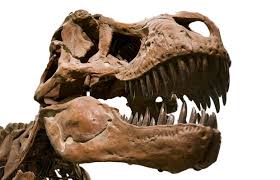
A model of a Tyrannosaurus rex skull.  
Likewise, some have contended that the supposedly mighty predator actually had a modest bite, limiting T. rex to scavenging.

To see how forcefully T. rex could bite, biomechanicists involved in the new study used laser scanners to digitize juvenile and adult T. rex skulls. The team then used computer models to reconstruct the dinosaur's jaw muscles and analyze bite performance.

The models suggest that an adult T. rex was capable of a maximum bite force of 35,000 to 57,000 newtons at its back teeth. That's more than four times higher than past estimates and ten times as forceful as the bite of a modern alligator.

T. rex, which went extinct about 65 million years ago, "probably lives up to its reputation as a ferocious biter," concluded study leader Karl Bates, a computational anatomist at the University of Liverpool in the United Kingdom.
 
T. Rex No Match for Megatooth?

Although T. rex may have possessed the most powerful bite of any land animal, it apparently paled in comparison to that of prehistoric megalodon—literally "megatooth"—sharks, which may have grown to lengths of more than 50 feet (16 meters) and weighed up to 30 times more than the largest great white.

Past megalodon research suggests these giant marine predators, which first appeared around 16 million years ago, could chomp with more than three times the force of T. rex, based on the new figures.

The bite force of a megalodon—"just because it was so much larger-bodied—would have been bigger," Bates said.

So T. rex could have bitten with ten times the force of an alligator. But would it have?

Answering that question would require an estimate of how much stress T. rex's skull could take, Bates said—to help pinpoint just how forcefully the predator could have bitten down with without hurting itself.

The T. rex bite study will be published online February 29 in the journal Biology

Sunday, October 28, 2012

Episode 4


Episode 3


Episode Two


Dinosaur Revolution Episode 1


Pterosaurus overview


What makes a pterosaur a pterosaur?
Firstly a pterosaur is not a dinosaur,‭ ‬the pterosaurs evolved from a different line to the one that gave rise to the dinosaurs.‭ ‬Nor are pterosaurs the ancestors of birds.‭ ‬Enough complete fossil evidence now exists to prove that birds evolved from the feathered dinosaurs.‭ ‬Also there is no such animal called a pterodactyl.‭ ‬This word is a shortened from of the name Pterodactylus,‭ ‬and as such‭ '‬pterodactyl‭' ‬does not represent any particular genus.
Pterosaurs are the earliest known vertebrates to master the air by flying,‭ ‬and until their evolution the only other animals in the air where flying insects.‭ ‬Pterosaurs are also the largest known flying animals ever known to exist,‭ ‬with even the largest of today‭’‬s bids not even coming close to the largest pterosaurs.

Discovery history
The first pterosaur known to science was Pterodactylus,‭ ‬although at the time not everybody was certain as to what it actually was.‭ ‬Back in‭ ‬1784‭ ‬when Pterodactylus was first described by the Italian naturalist Cosimo Alessandro,‭ ‬it was envisioned as an aquatic creature that used its‭ '‬wings‭' ‬to propel itself through the water.‭ ‬Amazingly even‭ ‬though the man who eventually named Pterodactylus,‭ ‬George Cuvier,‭ ‬put forward the correct theory that it was a flying creature,‭ ‬there were still many who held firm to the aquatic animal theory for several decades afterwards.
Despite this the idea that pterosaurs were flying creatures did rapidly gain acceptance,‭ ‬although the exact type of creature was still being debated amongst the scientific community of the time.‭ ‬Along with giving it the name,‭ ‬George Cuvier also noted that the specimen represented a reptile that could fly.‭ ‬Although he was correct,‭ ‬no such precedent for a flying reptile was known in the realms of natural history,‭ ‬and the very idea that a reptile could fly was simply beyond the imagination of many of the day’s naturalist.‭ ‬A more comfortable idea for them was that the pterosaurs were more like bats and possibly to an extent,‭ ‬the birds.
The problem with this apart from being incorrect biologically is that it also inferred similar behaviour and characteristics to pterosaurs.‭ ‬It would not be until fresh minds and the discovery of other fantastic reptiles such as the dinosaurs that people realised and accepted that reptiles once existed in forms that are completely different to anything we know today.
A further problem from the time is that the discovery of Pterodactylus was so radical to the world of science that it had the effect of many specimens being attributed to this genus as slightly different species of the same genus,‭ ‬when in actual fact they represented different kinds of pterosaur altogether.‭ ‬This‭ '‬wastebasket taxon‭' ‬effect is by no means unique to Pterodactylus or even the pterosaurs as a group,‭ ‬but at the time it caused much misunderstanding and confusion about pterosaurs.‭ ‬It would not be until the closing years of the twentieth century that the mass study between different specimens combined with the new knowledge of changing morphology between individuals of different ages of the same species,‭ ‬that many of the‭ '‬classic‭' ‬pterosaur genera could be cleaned up with the exhaustive lists of unnecessary species names got reduced to the actual representative types.‭
 
Classifications
Pterosaurs are usually broken down into the two groups called Rhamphorhynchoidea and Pterodactyloidea.‭ ‬Rhamphorhynchoid pterosaurs are the earliest group and represent basal pterosaurs like Rhamphorhynchus and Anurognathus.‭ ‬As a group they usually had long tails and shorter metacarpal bones in the wing.‭ ‬The group first enters the fossil record towards the end of the Triassic and lasts until the end of the Jurassic.
The pterodactyloid group are thought to have their origins from within the rhamphorhynchoid group,‭ ‬and first appear during the middle Jurassic.‭ ‬Named after Pterodactylus,‭ ‬they were more typified by having shorter tails and longer beaks more suited to piscivorous lifestyles,‭ ‬although some probably were still insectivorous,‭ ‬especially as juveniles.‭ ‬This group lasted until the end of the Cretaceous where they disappear from the fossil record along with the dinosaurs and the large marine reptiles.‭ The pterodactyloid group is further broken up into ornithocheiroidea,‭ ‬Ctenochasmatoidea,‭ ‬Dsungaripteroidea and Azhdarchoidea,‭ ‬all if which are termed‭ '‬superfamilies‭' ‬that can be broken down further into smaller groups of similarly related pterosaurs.
A third group called the Wukongopteridae also now exists,‭ ‬and is now the home for pterosaurs that display both primitive and advanced features.‭ ‬Although named after Wukongopterus,‭ ‬the most famous member of this group is called Darwinopterus.‭ ‬This pterosaur has been heralded as a transitional form,‭ ‬hence it’s naming after Charles Darwin who really brought the idea of evolution to the public consciousness.‭ ‬Classification of transitional forms is always difficult however which is not only why the Wukongopteridae was created,‭ ‬but a new currently unranked group called the Monofenestrata has now been created to appear before both the Wukongopteridae and much larger Pterodactyloidea super family.‭ ‬This is mainly because skull forms long associated with the Pterodactyloidea are now known to have existed in some more primitive forms as well.‭ ‬This is explained by fossil evidence that shows pterosaurs advanced through a process of modular evolution where only some body parts changed while others stayed the same.

Origins
With lightweight hollow bones and gracile builds,‭ ‬pterosaurs were very delicately built in life.‭ ‬Because their bones were hollow,‭ ‬they usually end up getting crushed under the weight of sediment deposits,‭ ‬and this not just produces flattened reliefs,‭ ‬but can cause some distortion to the shape of the bones.‭ ‬This means that only certain areas such as the Solnhofen beds in Germany and Araripe plateau of Brazil reveal detailed specimens.‭ ‬It is also why a clear lineage between pterosaurs and their immediate ancestors is for the most part largely unknown.‭
The pterosaurs most probably evolved from arboreal‭ (‬tree dwelling‭) ‬reptiles that had evolved thin growths of skin between their legs so that they could glide from tree to tree.‭ ‬Even though all this does is slow the rate of descent so that the animal can land on a tree before it hits the ground,‭ ‬the principal mechanism is there.‭ ‬Such a mechanism would be made more capable with a larger‭ '‬wing‭' ‬area and so the individuals with the larger wings could glide further and be more successful.‭ ‬Greater success would mean a greater number of offspring,‭ ‬which in turn would mean more,‭ ‬larger winged versions like the progenitor.
Larger wings would need stronger muscle attachment to move them around,‭ ‬and eventually the wings could not just be manipulated for steering,‭ ‬but also flapped so that the animal could go even further.‭ ‬Weight reduction from lighter bones,‭ ‬larger skull fenestra and reduction of non-essential body parts would eventually lead into a morphology resembling the earliest pterosaurs.
 
Biology
Pterosaurs had specially adapted bones which were exceptionally light weight.‭ ‬This was achieved by the bones being hollow and filled with air.‭ ‬These bones were also capable of maintaining rigid strength ensuring that the wings kept their shape.‭ ‬The drawback as stated above is that these bones were not very resilient to crushing forces such as the build-up of sediment.‭ ‬However this was not a problem for the living animal,‭ ‬as it would not be exposed to such forces until after it had died.
Many pterosaur species have the presence of pycnofibres preserved with their remains.‭ ‬Pycnofibres are the pterosaur equivalent of mammal hair,‭ ‬although the actual structure of hair and pycnofibres is actually quite different.‭ ‬The amount of pycnofibre coverage can vary greatly between species,‭ ‬with some kinds of pterosaur hardly having any coverage to others that had their entire bodies covered.
The purpose of pycnofibres is thought to have been exactly the same as the purpose for hair in mammals‭; ‬insulation.‭ ‬By having insulation,‭ ‬a pterosaur could maintain a higher internal body temperature,‭ ‬and has even led the idea that pterosaurs may have actually been warm blooded.‭ ‬By having a warm blooded metabolism,‭ ‬pterosaurs would have more easily been able to maintain the active movements required for flight.
A higher metabolism also means a higher rate of respiration,‭ ‬but evidence for this exists in the presence of internal air sacs.‭ ‬These air sacs would have helped to greatly increase the rate of respiration when active,‭ ‬and if they worked in the same way as air sacs in modern birds do,‭ ‬would have ensured that the lungs had available oxygen supply whether the pterosaur was breathing in or out.‭ ‬The drawback to a high metabolism is that it requires a high calorie intake to maintain.‭ ‬With this in mind it‭’‬s possible that some pterosaurs may have learned to use flight techniques such as‭ '‬dynamic soaring‭' ‬to reduce the required amount of calories,‭ ‬or lived lifestyles that required very little energy expenditure to find food.
CAT scanning of extinct animal skulls is now a common practice,‭ ‬and helps to reveal the layout and position of the brain and associated soft tissue of the creature when it was alive.‭ ‬This of course has been done with numerous pterosaurs,‭ ‬and here it is usually seen that the areas for determining balance are highly developed,‭ ‬indicating that pterosaurs were very adept at making precise adjustments in posture and wing movement.
Of particular importance is the orientation of the inner ear which can reveal if a pterosaur held its head straight and level with the body during flight,‭ ‬or down towards the ground at an angle.‭ ‬Not only can knowing this allow palaeontologists to infer to specific hunting strategies,‭ ‬in can also reveal information about the flight dynamics at work with the morphology of differing pterosaurs.
 
Wing structure
Pterosaur wings are often overlooked as being simple stretches of skin supported by a bony rod,‭ ‬when in all actuality nothing could be further from the truth.‭ ‬Pterosaur wings start with the arms which form the central support for the wing.‭ ‬Imagine looking down on the wing from the top down,‭ ‬you would see that the first part of the wing stretches from the wrist to the shoulder.‭ ‬This part of the wing is referred to as the Propatagium which was further supported by a bone called the pteroid,‭ ‬something that appears to be unique to pterosaurs.‭ ‬The arrangement of the pteroid continues to be a matter of dispute,‭ ‬as is its possible articulation.‭ ‬It could also be that how it worked may have varied according to different species.
The hands of pterosaurs had four fingers or‭ '‬digits‭' ‬as they are actually called.‭ ‬The first three digits were not connected to the wing and would likely have been of use in gripping to surfaces,‭ ‬especially in the smaller pterosaurs.‭ ‬The fourth digit was different to the first three in that it was extremely elongated,‭ ‬and it was in fact this‭ '‬finger‭' ‬that formed the main trailing edge support for the wing.‭
From the tip of the fourth digit towards the body and sometimes hind quarters was the main wing area.‭ ‬This is called the Brachiopatagium,‭ ‬although‭ ‬it is often hard to ascertain where exactly it joined the main pterosaur body.‭ ‬Fossil evidence of some pterosaurs where soft tissue impressions have been preserved such as with the pterosaur Sordes,‭ ‬show that the wings connected to the hind limbs,‭ ‬but it is uncertain if this applies to all pterosaurs.‭ ‬Despite the evidence that supports the joining of the wing to the hind limbs,‭ ‬it is very likely that the exact area of attachment was more dependent upon the individual species of pterosaur.
The actual construction of the wing area is more than just a skin membrane.‭ ‬The wings had a latticework of fibres known as actinofibrils.‭ ‬This criss-crossing arrangement would have helped strengthen the wing especially during in-flight manoeuvres.‭ ‬The internal structure of the wings also included a small amount of muscle and a network of circular blood vessels.‭ ‬Larger pterosaurs also seem to have had air sacs present in their wings as well.‭ ‬Whether these sacs were for weight reduction or even an aid for respiration for a larger pterosaur is hard to establish with certainty.
Some pterosaurs,‭ ‬particularly some members of the more basal rhamphorhynchoid group,‭ ‬also have a membrane between their hind legs.‭ ‬This is called the Uropatagium,‭ ‬but its precise function remains unknown,‭ ‬and its extent most certainly varied between species.‭ ‬It could have acted like an‭ '‬air brake‭' ‬used when the pterosaur descended to land,‭ ‬or for pulling a tight manoeuvre when chasing agile prey.‭ ‬This feature could have been a throwback to a feature present in pterosaur ancestors,‭ ‬as it seems to be largely absent from the lore advanced pterosaurs.
 
Flight
In the early days of pterosaur discovery most researchers considered them to be only capable of gliding and as such reliant upon thermal currents and up draughts to maintain flight.‭ ‬This in part was fuelled by the notion that all reptiles,‭ ‬based on those we know today,‭ ‬are cold blooded.‭ ‬A cold blooded creature they thought would be required to glide to reduce the need for active muscle movement,‭ ‬something associated with warm blooded animals.‭ ‬It was also thought that some of the larger kinds such as Pteranodon had wings that were simply too big to flap up and down.‭
Today the idea that pterosaurs could only glide is laughably obsolete,‭ ‬although it is recognised that some pterosaurs especially the larger varieties may have glided for extended periods in order to reduce the amount of calories required for flight.‭ ‬This would have been especially useful for pterosaurs that required keeping their energy expenditure to a minimum when searching for prey.
Smaller pterosaurs certainly did not glide when chasing after insectivorous prey.‭ ‬Anyone who has seen a dragonfly on the wing can appreciate how sudden they can turn without even a hint of slowing down,‭ ‬and capturing such manoeuvrable prey by just gliding after it would be near impossible.
Larger pterosaurs like Pteranodon are thought to have hunted for fish across the open ocean and as such spent extended periods away from land.‭ ‬In order to reduce their expenditure they did not just simply glide but may have used a method referred to as dynamic soaring,‭ ‬in this case a method of exploiting the air patterns over the ocean waves.
By flying low into a trough between two sets of waves,‭ ‬a Pteranodon could turn into the oncoming wind as it rises over the crest of a wave.‭ ‬Because the air has to rise over the wave,‭ ‬it gets packed together increasing its pressure.‭ ‬This increased pressure would cause the Pteranodon to rise up into the air without any effort on its part.‭ ‬Once up,‭ ‬the Pteranodon could then change direction and dive again,‭ ‬this time with the wind behind it,‭ ‬increasing its speed so that the next time it pulls the manoeuvre the effect is even greater.‭
This building of momentum by using the wind is the exact same method used by a modern day Albatross,‭ ‬a bird of similar size and wing area to Pteranodon.‭ ‬The principal of dynamic soaring is also used by glider pilots to remain airborne for longer.
The exact flight technique used by pterosaurs is still not known with certainty,‭ ‬although much study has been done,‭ ‬including flying model reconstructions of pterosaurs.‭ ‬Now making a working model of a living creature that has all the degrees of motion that the original animal has is a very difficult task.‭ ‬The National Geographic‭ '‬Sky Monsters‭' ‬documentary featured a groups attempt to create a flying pterosaur model.‭ ‬Due to technological limitations the model was carried up by a remote aircraft which then released the model in flight.‭ ‬Although technical failure of the parts inside meant that the demonstration was unsuccessful,‭ ‬the group still managed to demonstrate the aerodynamics of a pterosaur wing and basic manoeuvring ability.
A very exciting possibility is that pterosaurs were able to fly soon after hatching from the egg.‭ ‬This is evidenced by looking at the proportions of the wing bones throughout the growth stages.‭ ‬Juvenile specimens often exhibit morphological differences from their adult forms,‭ ‬but the proportions of the wing bones always remain the same with the different wing bones growing at the same rate as one another.‭ ‬This indicates that the wings of a pterosaur juvenile were just as flight capable as when they grew larger in later life.
How pterosaurs got airborne is another disputed area with early depictions hailing from the time when they were thought to only glide,‭ ‬which had pterosaurs leaping from cliff tops and catching the strong up draughts in their wings.‭ ‬While this can be still used as a model for some species,‭ ‬it cannot be applied to all pterosaurs.‭ ‬Fossilised track‭ ‬ways prove that pterosaurs spent time on the ground,‭ ‬and some researchers think that they could have run while flapping.‭
Another theory,‭ ‬one that is gaining wider acceptance,‭ ‬is that pterosaurs could‭ '‬vault‭' ‬themselves into the air.‭ ‬This would work by suddenly pushing their bodies off the ground with their wings.‭ ‬Once off the ground,‭ ‬they would then lift their wings and begin flapping towards the ground to give them lift.‭ ‬This makes good sense as the muscles that moved the wings were probably the strongest in the body.‭ ‬Couple this with the lightweight construction of the skeleton,‭ ‬and it‭’‬s easy to imagine a pterosaur pushing itself into the air before flying off.
 
Ground movement
When pterosaurs were first realised to be flying animals,‭ ‬they were thought to have perched in trees like birds.‭ ‬The summarisation for this was simple‭; ‬birds fly,‭ ‬pterosaurs flew,‭ ‬therefore pterosaurs must have perched like birds.‭ ‬Although some pterosaurs did indeed live in the tree canopy,‭ ‬and probably rested on branches,‭ ‬it is now accepted that the vast majority of pterosaurs lived on the ground when not flying.‭ ‬However,‭ ‬pterosaurs likely chose their resting places carefully,‭ ‬perhaps preferring high up,‭ ‬hard to reach places like rock outcroppings and plateaus away from predators like carnivorous dinosaurs.
Because of continuing comparisons to birds,‭ ‬pterosaurs were also thought to have been bipedal when on the ground.‭ ‬This led to the now out-dated reconstruction of pterosaurs holding their wings up to keep them off the ground,‭ ‬something that is considered extremely unlikely for a resting posture.‭ ‬For example,‭ ‬if you try holding your arms out to your side,‭ ‬you'll find that while you can keep them there for a short period of time,‭ ‬they'll eventually start to ache after a bit.‭ ‬In pterosaurs,‭ ‬the bones were lighter,‭ ‬but in order to maintain the posture they would still have to be tensing muscles to keep their wings high.
Today the fossilised track ways of pterosaurs are well documented,‭ ‬and these clearly show not only the rear feet,‭ ‬but the hands of the wings in contact with the ground,‭ ‬confirming that pterosaurs did indeed walk‭ ‬in a‭ ‬quadrupedal‭ ‬fashion‭ ‬when on the ground.‭ ‬Study also shows that some pterosaurs walked with the wings supporting the body from underneath as opposed to the sides.
How well a pterosaur moved on the land depended somewhat on the species in question.‭ ‬Pterosaurs with larger feet were suited to walking on soft ground like the muddy banks of a lake or river,‭ ‬while those with smaller feet were more suited to dry and firm soil.‭ ‬Some pterosaurs are even thought to have been able to run,‭ ‬perhaps to chase after prey items that tried to escape by running into the undergrowth,‭ ‬giving them a taller,‭ ‬erect walking gait.

Reproduction‭ & ‬growth
As briefly mentioned above,‭ ‬much of the confusion over numerous pterosaur species came from the fact that no one knew how much pterosaurs changed during their lives.‭ ‬These changes can be seen in some species where the juvenile specimens have radically different skeletal structures to those of the adults.‭ ‬Often the most striking difference is the length and proportion of the skull.‭ ‬A common trait is juveniles having shorter jaws and dentition more suited to catching insects,‭ ‬where in adults the jaws are proportionately longer,‭ ‬with teeth suited more seizing fish.
These changes are best known for pterosaurs where multiple remains exist for the genera which clearly show the changing morphology across different aged individuals.‭ ‬It also suggests that the younger individuals of a pterosaur species filled a different ecological niche to that of their parents,‭ ‬thereby avoiding direct competition with them.
The size of the hips in pterosaur remains is usually taken as a reliable indicator between male and female individuals,‭ ‬with females having wider hips to help with the passage of eggs.‭ ‬This is taken as a more reliable indicator than the study of crests which can change greatly over the course of a pterosaurs life,‭ ‬especially in males.
The ratio of female to male remains is considered by some to be an indicator of the reproductive habits of some pterosaurs.‭ ‬InPteranodon the number of females greatly outnumbers the number of males,‭ ‬especially the mature males with fully developed crests.‭ ‬This has been interpreted as males taking up residence in a particular area and living a polyganous lifestyle,‭ ‬mating with all the females that are within their territory.‭ ‬Such behaviour would mean that males would constantly have to defend their territory,‭ ‬and only the most successful males would breed.‭ ‬This competition may also have driven out the lesser males,‭ ‬possibly stunting their development by driving them away from the main gathering and feeding areas,‭ ‬reducing their chances of surviving long enough to reach full maturity.
Due to the diverse nature of different pterosaur species,‭ ‬it is uncertain how well this model can be applied to other species.‭ ‬It is just as probable that some pterosaurs could have formed loose colonies of mating pairs,‭ ‬or perhaps isolated themselves from a larger group while nesting.

Display crests
Although not all pterosaurs have crests,‭ ‬those that do can truly astound palaeontologists.‭ ‬Crest shapes can vary from simple raised structures only a few centimetres high to the preposterously ornate and huge crests on others like Nyctosaurus,‭ ‬whose‭ ‘‬L shaped‭’ ‬head crest is over half as high as one of its wings is long.‭ ‬Crests are also not just restricted to the back of the head,‭ ‬but can also run forwards and down the snout as well.
The easy explanation for these crests is that they were primarily for display.‭ ‬The display answer covers both inter species recognition so that two pterosaurs of the same species can recognise each other,‭ ‬as well as for the purpose of attracting a mate.‭ ‬The latter is a very credible theory as the study of male pterosaur specimens of the same species but different ages reveals that the crests only became fully developed when the males reached reproductive maturity.‭
Female pterosaurs of crested species also had crests of their own,‭ ‬although usually they were not as developed as the males,‭ ‬and this has in the past caused confusion between female and immature male specimens.‭ ‬Aside from the shape of the crest,‭ ‬it is highly plausible that crests may have been brightly coloured to accentuate their presence,‭ ‬especially if pterosaurs had specific breeding seasons.
Some pterosaur researchers also speculate upon other functions that can be attributed to crests.‭ ‬The higher and broader crests are considered by some to have acted like rudders,‭ ‬helping with steering during flight.‭ ‬Some of the broader crests or‭ '‬head sails‭' ‬like in the tapejarids may have been able to‭ ‬catch the wind,‭ ‬reducing the amount of work necessary for a pterosaur to keep itself airborne.‭
Many studies have been conducted upon the aerodynamic effects of different head crests,‭ ‬and for the most part,‭ ‬no overly negative or positive effects have been noted.‭ ‬What is known is that not all pterosaurs had crests,‭ ‬and those that do have such large variation between different species,‭ ‬that the only universal explanation that can be applied to all pterosaurs is display.

Daily activity
One of the most common fossilised parts of pterosaur remains where the skull has been preserved are the scleral rings.‭ ‬Study of how these rings can reveal important insights into the life of the living creature,‭ ‬such as if it was active by day or during the night.‭ ‬This is sometimes referred to as niche partitioning,‭ ‬and means that a pterosaur that is active throughout the night would avoid direct competition with another species of pterosaur that was active in the same area but during the day instead.
Being active at different times can also be because a particular food supply was more abundant at certain times of the day.‭ ‬Also,‭ ‬it can be a survival strategy to avoid hunters.‭ ‬Some creatures are known to be active only during the twilight of dusk and dawn to avoid the predators of both the day and the night.

Diet
The earliest pterosaurs were most likely to have been insectivores,‭ ‬and many of the later examples such as Jeholopterus show specialised adaptations for this way of life.‭ Later members of the pterosaurs started to include fish into their diets,‭ ‬with some such asPterodactylus and Rhamphorhynchus being considered to take either fish or insects.‭ ‬It is also highly probable that what pterosaurs ate depends on how old they were,‭ ‬with juvenile specimens having shorter beaks with thin pointed teeth more suitable for insects,‭ ‬whereas older members of the same species having proportionately longer beaks,‭ ‬with stronger teeth more suited to a fish diet.
Pterosaurs that did have a piscivorous diet are usually imagined as hunting by skim fishing.‭ ‬This is where the pterosaur would fly so close to the water that when it opened its jaws at least the lower jaw dipped beneath the surface of the water.‭ ‬When the jaw hit a fish the jaws were closed,‭ ‬and the pterosaur then carried the fish from the water.‭
Many species of pterosaur have teeth that are actually smaller near the tip of the beak,‭ ‬becoming larger towards the back,‭ ‬sometimes to the extent that two groups of teeth can be clearly be identified.‭ ‬At a glance it may seem unusual when you compare this dentition arrangement to other predators which typically have the larger teeth at the front for prey capture,‭ ‬but you have to bear in mind the resistance of the water against the tip of the beak when travelling through the water at speed.‭ ‬Larger teeth would create more resistance,‭ ‬making skim feeding more cumbersome and possibly reducing reaction time in closing the jaws around the prey.‭ ‬Smaller teeth are not so much of a problem,‭ ‬and it would be a simple technique for a pterosaur to seize its prey with the tip of its beak before quickly flicking its head back and tossing its prey further back into its mouth where it could then be held by the larger teeth.‭ ‬Not only would this allow more grip on a struggling fish,‭ ‬it may have allowed the hunter to better protect its meal from other marauding pterosaurs that may have tried to steal its prey.
On the over hand some pterosaurs like Zhenyuanopterus had quite the reverse with larger teeth towards the front and much smaller teeth towards the back.‭ ‬The strength of the teeth need to be taken into consideration,‭ ‬and many people think that they would have been too fragile to cope with larger and more powerful prey.‭ ‬It may be that pterosaurs with this kind of dentition focused their attentions on smaller prey,‭ ‬and perhaps used a dipping motion to pluck fish out of the water.
Some pterosaurs actually had toothless beaks but still managed to have been active hunters.‭ ‬Pteranodon,‭ ‬whose name translates to English as‭ '‬Toothless wing‭' ‬was almost certainly a dedicated piscivore,‭ ‬as evidenced by the large amount of fish remains such as bones and scales that are often found inside Pteranodon remains.‭ ‬New thinking to Pteranodon‭’‬s feeding strategy has brought the proposition that it did not just scoop up fish as it flew overhead,‭ ‬but may have actually landed on the water,‭ ‬or even dived into it from a height like Gannets do today.
Not all pterosaurs were thought to have fed while on the wing and the azhdarchoid line of pterosaurs that include members likeQuetzalcoatlus and Zhejiangopterus,‭ ‬which are now thought to have hunted for food like storks do today.‭ ‬Not only could this include hunting like plucking fish from the water’s edge,‭ ‬it could also include stalking through long grass to find things like snakes and lizards to eat.
One of the most specialist pterosaurs was Peterodaustro,‭ ‬a filter feeding pterosaur that perhaps lived like a modern day flamingo.‭ ‬Pterodaustro had a beak that curved upwards that instead of being filled with strong needle teeth like some other pterosaurs,‭ ‬it‭ ‬had up to a thousand bristle teeth that protruded upwards from the lower jaw.‭ ‬These highly specialised teeth would have allowed Pterodaustroto scoop up a beak full of water,‭ ‬and then strain it out so that only a beak full of small invertebrates,‭ ‬plankton and algae would remain.
It's also entirely probable that some pterosaurs were scavengers looking for carrion while out in the wing like vultures do today.‭ ‬A gliding flyer would have expended very little energy while still covering a massive area in its pursuit for food.
Not all pterosaurs may have been carnivorous however.‭ ‬Some palaeontologists have put forward the idea that some pterosaurs also included fruit in their diets,‭ ‬making them possibly omnivores,‭ ‬or to the extreme end of the scale,‭ ‬frugivores.

Predators
Pterosaurs would have been attacked and eaten by any predator able to get to them.‭ ‬There is a reported case of a spinosaurid tooth embedded in the vertebra of a pterosaur,‭ ‬and the tooth of a dromaeosaurid dinosaur embedded in pterosaur remains from Canada.‭ ‬Pterosaurs would also need to drink,‭ ‬a time when they were probably at their most vulnerable as there were not just dinosaurs,‭ ‬but large crocodiles lurking in the water.‭ ‬At sea,‭ ‬they would have had to avoid plesiosaurs and mosasaurs,‭ ‬and if some did indeed take to the water during feeding,‭ ‬then sharks may have been a problem too.‭ ‬It is also possible that some larger pterosaur genera may have fed upon the smaller species.‭ ‬The pterosaur one main survival advantage was that as flyers,‭ ‬they would have been out of reach of any of the terrestrial and marine predators when flying high.

Extinction
No one can agree exactly on what finished the pterosaurs,‭ ‬but one popular theory is competition with the newly evolved birds.‭ ‬The birds are generally thought to have been more manoeuvrable,‭ ‬and more resilient to harm than the pterosaurs,‭ ‬and simply outcompeted them.‭ ‬This may actually be true for the rhamphorhynchoid group that largely disappeared at the end of the Jurassic.‭ ‬The rhamphorhynchoid group had more of a focus on being insectivores,‭ ‬and when the birds appeared,‭ ‬the food supply could not support both kinds of creature indefinitely,‭ ‬especially if the birds were more successful breeders,‭ ‬raising more successful broods with a higher number of young.
However the appearance of birds on its own cannot explain the disappearance of the pterodactyloid group,‭ ‬although they did probably help drive the smaller members of the group to extinction by being more successful,‭ ‬as well as competing with the juvenile forms of some pterosaur species.‭ ‬The larger members such as Pteranodon and Quetzalcoatlus however survived to the very end and had lifestyles that kept them out of direct competition with birds.
It‭’‬s highly probable that the asteroid impact that marked the end of the Cretaceous caused a severe reduction in marine life.‭ ‬This would have happened from large amounts of dust and debris being thrown up into the atmosphere from the impact reducing the amount of light falling upon the world‭’‬s oceans.‭ ‬This would cause a massive drop in the amount of phytoplankton which would be food to fish and by extension everything that preyed and relied upon the fish to survive.‭ ‬The long term survival of all animals that relied upon fish would have been bleak,‭ ‬and only a few weeks of starvation at most would have been enough to finish most of the predators.‭ ‬By the time the phytoplankton and the fish stocks began to recover it was already too late.
It would not have been plain sailing for pterosaurs that lived on the land and ate other prey items either.‭ ‬The ensuing darkness may have affected their ability to see to hunt,‭ ‬and weather patterns may have also been chaotic in the immediate aftermath of the impact,‭ ‬making flying difficult if not impossible.‭ ‬Also many of the later pterosaurs had grown gigantic,‭ ‬and as such would require a much larger calorie intake to survive.‭ ‬If it were not maintained,‭ ‬they too would eventually starve.
When considering what one event finished a group,‭ ‬it is more likely that it was not just one thing,‭ ‬but an amalgamation of several different factors that brought the end for the pterosaurs.

Really‭ ‬extinct‭?
Even though pterosaurs are considered to be an extinct group,‭ ‬in cryptozoological circles,‭ ‬occasional descriptions of animals that match those of ancient pterosaurs are still sometimes made.‭ ‬These sightings usually come from eye witnesses who claim to have been‭ '‬buzzed‭' ‬by a creature while they were out about their business,‭ ‬or explorers who have heard reports of pterosaur like creatures from native peoples,‭ ‬who in turn recognise and pick out images of pterosaurs as the creatures in their stories when they are shown them.‭ ‬There have even been cave drawings made several thousand years ago that feature drawings of winged creatures that resemble pterosaurs.
Although some researchers continue to search for the existence of living pterosaurs,‭ ‬these sightings are not accepted by the wider scientific community.‭ ‬They do however serve as writing material for popular fiction in the same way as the Loch Ness Monster gets described as being a plesiosaur.

Saturday, October 27, 2012

The Strongest Bite


A researcher tests an alligator's bite strength.

Paleobiologist Gregory M. Erickson and colleagues put all 23 living crocodilian species through an unprecedented bite test. The "winners"—saltwater crocodiles—slammed their jaws shut with 3,700 pounds per square inch (psi), or 16,460 newtons, of bite force.


By contrast, you might tear into a steak with 150 to 200 psi (890 newtons). Hyenas, lions, and tigers generate around 1,000 psi (4,450 newtons).

And while a 2008 computer model estimated that a 21-foot (6.5-meter) great white shark would produce nearly 4,000 psi (17,790 newtons) of bite force, that figure hasn't been directly measured.

Erickson and colleagues did physically measure the bites of several 17-foot (5.2-meter) saltwater crocs—as well as Nile crocodiles, alligators, caimans,gharials, and other crocs, some for the first time ever.

The team spent countless hours wrestling with the reptiles at Florida's St. Augustine Alligator Farm Zoological Park and getting them to bite a force transducer—a "very expensive, very durable, waterproof bathroom scale that's padded with leather."

"The testing is like dragon slaying by committee, often involving ten or more people to test a single animal," said Erickson, of Florida State University.

For every croc species, the transducer registered impressive power, suggesting that a big bite is at the heart of what it means to be a crocodilian, according to Erickson.

"That's why I think they've been so successful," he said. "They seized on a remarkable design for producing bite force and pressure to occupy ecological niches on the water's edge for 85 million years, and no one else evolved that could wrest those niches from them."
 
Bite From the Start

Surprisingly, at least to Erickson, variations in the bite forces of croc species turn out to be largely based on body size. In many animal groups this variation is tied to differing jaw shapes and tooth forms, but those features didn't much affect the croc chomps in the team's tests.

This suggests crocs were big biters from the dawn of their evolutionary line, said Erickson, a grantee of the National Geographic Society's Committee for Research and Exploration.

Crocodiles may be the world's champion chompers, killing with the greatest bite force ever directly measured for living animals, a new study says. In fact, their bite forces may rival that of mighty T. rex.

Crocodiles may be the world's champion chompers, killing with the greatest bite force ever directly measured for living animals, a new study says. In fact, their bite forces may rival that of mighty T. rex.


"I think the most primitive development of the crocs was basically as a force-generating machine," Erickson said. Variations in snouts and teeth arose later, fine-tuning that powerful bite for prey ranging from fish and snakes to birds, mammals, and even insects.

"Think of a Weed Eater with a big engine that has different attachments, like a grass cutter or a tree trimmer. During evolution [crocs] basically played around with those sorts of attachments," said Erickson, who led the new study, published Wednesday in the journal PLoS ONE.

In a typical croc environment, "big game comes to the water's edge, mollusks grow there, birds land—and anything that's around that water, they can eat it."

Paleobiologist Laura Porro, who wasn't involved in the new research, added, "People have been talking about how differences in snout shape and tooth shape and diet may impact crocodilian biomechanics, but no one has been able to collect all these data. It's extraordinary."

Mind-Boggling Bites of Crocs Past

In addition to shedding light on living crocs, the new data could illuminate the extinct animals at the roots of the croc family tree, said Porro, of the University of Chicago, who studies live alligators but also models biomechanics of extinct reptiles.

"This kind of work with living animals can help us try to validate our models," she said. "And I think you could definitely extend this model to the fossil crocs, even the giant ones, that look relatively similar to modern crocs."

Erickson and team have already done some such scaling—producing an image of a truly ferocious ancient croc.

"We tested several 17-foot [5-meter] saltwater crocs," he said. "If you scale the results up to 20-footers, you get estimates of 7,700 pounds [34,250 newtons], which is the low end of T. rex bite-force estimates.

"So if you want to see what T. Rex bite force looks like, go look at one of these crocs."

Furthermore, by Erickson's calculations, the extinct, limousine-sizeDeinosuchus, or "terrible crocodile," had an estimated bite force as high as 23,100 psi (102,750 newtons)—greater even than new estimates that put T. rex's bite at 12,814 psi (57,000 newtons).

"It's mind-boggling to think about that one," he said.
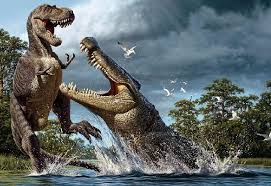


The University of Chicago's Porro noted that no Tyrannosaurus rex muscle survives, so estimates for the dinosaur's bite force are based on its body size, wide skull and short snout.

Those T. rex bones look capable of a stronger bite than any croc's, Porro said. "But then again, if you dissect a croc's head, it's amazing just how much muscle mass they have. They have huge jowls ... all jaw-closing muscle, so who knows?" she said. "Maybe it's a matter of crocs just having more muscle."

We may never know for sure whether a croc or a tyrannosaur was the world's all-time champion chomper (and in any case, a giant prehistoric shark likely has both beat).

"There is always going to be some uncertainty," Porro said.

Modern crocs are remarkably similar to prehistoric ones, which in some ways makes things easy for ancient-croc researchers, she noted. But "we have nothing today that looks very much like a T. rex."

Two New Species of Horned Dinosaur Named


Two new horned dinosaurs have been named based on fossils collected from Alberta, Canada. The new species, Unescopceratops koppelhusae and Gryphoceratops morrisoni, are from the Leptoceratopsidae family of horned dinosaurs. The herbivores lived during the Late Cretaceous period between 75 to 83 million years ago. The specimens are described in research published in the Jan. 24, 2012, online issue of the journal Cretaceous Research.

"These dinosaurs fill important gaps in the evolutionary history of small-bodied horned dinosaurs that lack the large horns and frills of relatives like Triceratops from North America," said Michael Ryan, Ph.D., curator of vertebrate paleontology at The Cleveland Museum of Natural History, lead author on the research. "Although horned dinosaurs originated in Asia, our analysis suggests that leptoceratopsids radiated to North America and diversified here, since the new species, Gryphoceratops, is the earliest record of the group on this continent."

Unescoceratops koppelhusae lived approximately 75 million years ago. It measured about one to two meters (6.5 feet) in length and weighed less than 91 kilograms (200 pounds). It had a short frill extending from behind its head but did not have ornamentation on its skull. It had a parrot-like beak. Its teeth were lower and rounder than those of any other leptoceratopsid. In addition, its hatchet-shaped jaw had a distinct portion of bone that projected below the jaw like a small chin.

The lower left jaw fragment of Unescoceratops was discovered in 1995 in Dinosaur Provincial Park, a United Nations Educational, Scientific and Cultural Organization (UNESCO) World Heritage Site by Philip Currie, Ph.D., now of the University of Alberta. Originally described in 1998 by Ryan and Currie, the dinosaur was referred to as Leptoceratops. Subsequent research by Ryan and David Evans, Ph.D., of the Royal Ontario Museum in Toronto, Canada, determined the specimen was a new genus and species. The genus is named to honor the UNESCO World Heritage Site designation for the locality where the specimen was found and from the Greek "ceratops," which means "horned face." The species is named for Eva Koppelhus, Ph.D., a palynologist at the University of Alberta and wife of Currie.

Gryphoceratops morrisoni lived about 83 million years ago. It had a shorter and deeper jaw shape than any other leptoceratopsid. Researchers believe the individual was a full-grown adult. Based on unique characteristics of the jaw and its size, the researchers believe that Gryphoceratops was an adult that did not exceed one-half meter in length. This means it is the smallest adult-sized horned dinosaur in North America and one of the smallest adult-sized plant-eating dinosaurs known.

Lower right jaw fragments of Gryphoceratops were discovered in southern Alberta in 1950 by Levi Sternberg while he worked for the Royal Ontario Museum. The genus is named for "Gryphon," a mythological Greek figure with the body of a lion and the head of an eagle, which is a reference to the animal's beaked face. The species name honors Ian Morrison, a Royal Ontario Museum technician, who discovered how the bones fit together.

Second author Evans, associate curator of vertebrate palaeontology at the Royal Ontario Museum and assistant professor at the University of Toronto, said, "Small-bodied dinosaurs are typically poorly represented in the fossil record, which is why fragmentary remains like these new leptoceratopsids can make a big contribution to our understanding of dinosaur ecology and evolution."

Contributing authors are Philip Currie, Ph.D., of the University of Alberta; Caleb Brown of the University of Toronto; and Don Brinkman, Ph.D., of the Royal Tyrrell Museum of Palaeontology.

Ancestor of Biggest Dinosaurs: First Dinosaur Discovered in Spain Dates Back 15 Million Years Earlier Than Thought

 
A research group from Aragon, that has the same name as the first Aragosaurus ischiaticus dinosaur discovered 25 years ago in Teruel, reveals that it lived 15 million years earlier than originally believed. Its new dating means that it was the ancestor of the Titanosauri forms, which includes the biggest dinosaurs.

 The Aragosaurus was the first sauropod dinosaur described in Spain some 25 years ago in Galve (Teruel), but its age was never clear. The new dating would make it the only dinosaur of the Hauterivian age (between 136 and 130 million years ago) to be found in Spain.

"This is the only dinosaur of this period found in Spain and is also the most intact in Europe. It can be categorised amongst the well known sauropods of the Jurassic-Cretaceous transition (135 million years ago), the most abundant species during the Barremian age (116 million years ago). As this group has been studied the least, theAragosaurus fills the gap," explains José Ignacio Canudo, lead author of the study and researcher in the University of Zaragoza'sAragosaurus-IUCA Group, which stands for the Aragon Research Institute of Environmental Sciences.

Its new age means that Aragosaurusfills in the transitional period between the Jurassic and Cretaceous periods, of which there is little record in the world. Canudo points out that, "Aragosaurus would have therefore been a primitive ancestor of the titanosauraus sauropods that would later dominate Europe and Asia during the Late Cretaceous Period."

Published in Geological Magazine, the study shows thatAragosaurus, found by José Luis Sanz and his team in 1987, is the oldest of its kind ever found and it could even be a common ancestor. The researcher said that, "the group could have originated in Europe, or even in Iberia, but there is still a lot more to be found out."

The new finding also reveals that in the Early Cretaceous Period (135 million years ago), what we now know as the European Continent was made up of a series of large islands that could have been, "the point of origin for many vertebrate groups including sauropod dinosaurs like the Basal Titanosauriform."

Fossil dating: An "almost" impossible mission

In order to situate the dinosaurs on their corresponding branch of the evolutionary tree, their remains require dating. In some cases though, this is lacking. Dating dinosaur remains can be problematic due the little information available on the age of the sediments where the fossils lie.

In relation to Aragosaurus ischiaticus "there are some lagoons that allude to its stratigraphic position," outlines Candudo, adding that dating "can often be complicated due to imprecision in continental scales." For this reason, the age of some dinosaur species can vary "even by tens of millions of years," assures the geologist.

The research group carried out their detailed geological field work to find the remains in the lower part of the Castellar Formation site in Teruel. As the lower part is "not as rich" in fossils compared to the upper part, the only Aragosaurusremains that could be dated were a pollen fossil assemblage.

In Canudo's opinion, specifying the age of dinosaurs is "fundamental" in determining the paleobiogeography and evolution of these beings. As the scientist concludes, "incorrect aging provides the wrong results when determining the correlation between continents."

Do you like this post? Follow my RSS-feed 
Related Posts Plugin for WordPress, Blogger...